02 / GEOGRAPHY & DAIRY
Start with the landscape
The Alps are not one food region with one uniform cuisine. Valleys differ in altitude, climate, transport links, languages and farming patterns. Those differences affect which animals are kept, when grazing is possible, how milk is handled and which foods become part of local meals. A broad label such as “Alpine cheese” describes a family of connected traditions, not a single recipe or protected style.
Mountain geography also shapes movement. A valley can connect communities across a ridge or border, while nearby settlements may have distinct speech, customs and production choices. Food practices do not stop neatly at modern national boundaries. Treating every cheese or dish as exclusive to one country can flatten a more complex regional history.
Valleys, slopes and mountain pastures
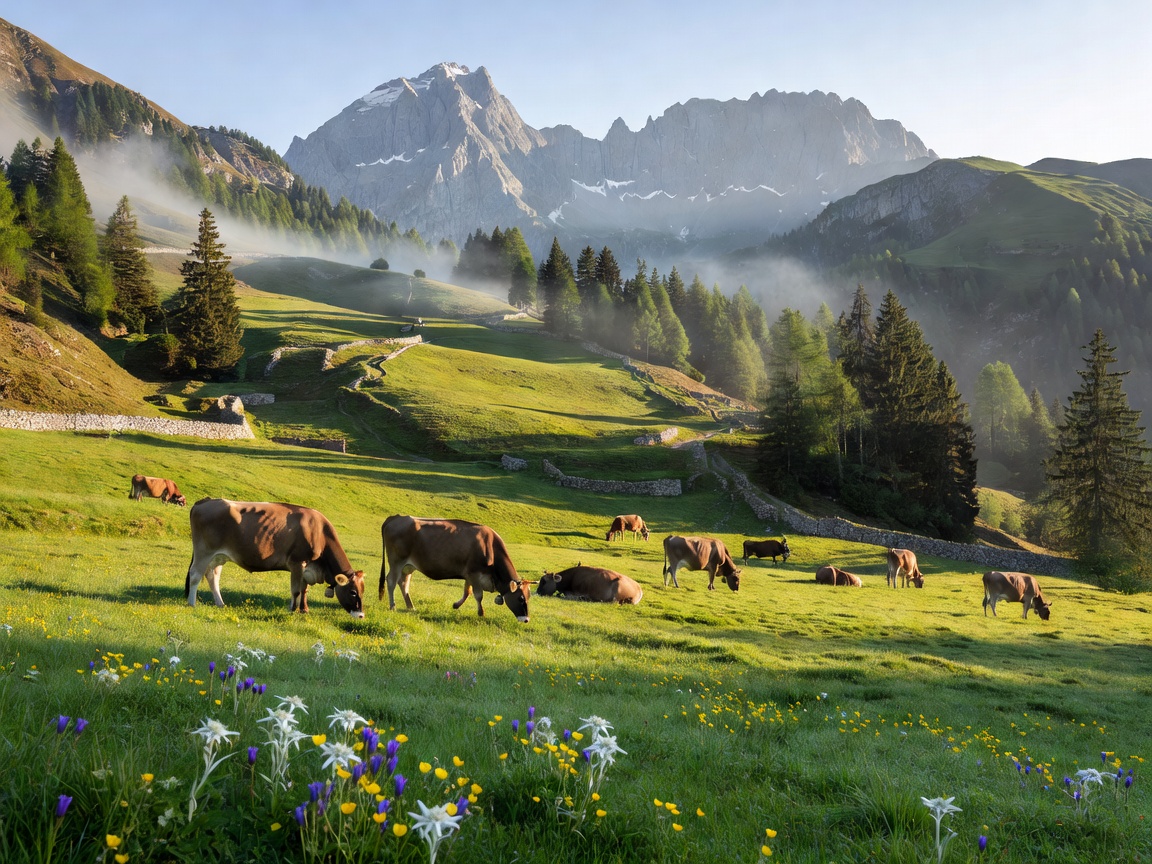
A valley floor, a mid-slope farm and a high summer pasture offer different conditions and access. Mountain pasture means grazing land used at higher elevations during suitable months. Seasonal movement of livestock between lower farms and higher grazing areas is one pattern found in Alpine agriculture, though the exact system differs from place to place. Elevation alone does not determine a cheese’s flavour or identity; breed, feed, milk handling, recipe and maturation also matter.
Pasture use follows weather and local working arrangements. A short grazing window can influence when animals are moved and when milk is available for processing. In some communities, dairy work is connected to seasonal mountain facilities. Elsewhere, milk may travel to a village dairy or a larger processor. Do not assume every mountain cheese is made at altitude or that all production follows the same seasonal cycle.
Milk traditions and processing
Milk is the starting material, but it is not the whole explanation. Cow’s milk is common across many familiar Alpine cheese traditions; goat’s and sheep’s milk also appear in regional dairy practices. The species, feed, handling and cheesemaking method all contribute to distinct products. A local label or producer description is more reliable than guessing from the landscape in a photograph.
Cheese can be fresh, soft, semi-firm or firm, and it can be eaten young or matured. These broad categories describe texture and handling, not a complete regional identity. Heating, curd treatment, pressing, salting and aging are among the methods that distinguish cheeses. Details are specific to each cheese and producer, so a general guide should not substitute for a product’s own description.
Regional comparison: useful lenses
| Regional lens | What to notice | Question to ask |
|---|---|---|
| Valley dairy | Local milk collection, village processing and nearby markets | Which milk and cheese styles are identified on the menu? |
| Pasture-linked tradition | Seasonal grazing and the relationship between farm and higher land | Is the product described as seasonal or pasture-associated? |
| Cross-border corridor | Trade, language contact and food practices shared across a mountain route | Does the guide describe a broad region rather than one country? |
| Tourist centre | Local dishes presented alongside food from elsewhere | Which items are regional, and which are general menu choices? |
Named examples and careful attribution
Some cheeses are identifiable by established names. Gruyère and Emmental are real, widely recognized examples associated with Swiss cheese traditions; Beaufort is a named cheese associated with the French Alps. These examples do not represent every local practice, and a name alone does not explain where a particular serving was made. Check the product description for origin, milk and producer information where those details matter.
Names and protected designations can have formal rules. This guide does not verify the status of a particular product, restaurant or claim. If origin is important to a purchase, consult the producer’s documentation or relevant official specification rather than relying on a general menu phrase.
Read a region through its food
In a restaurant, compare the cheese list with the dishes around it. A local cheese board can show several textures; a baked preparation may use one cheese suited to heat; a fondue blend may combine cheeses. Ask how a dish is prepared and whether the menu identifies regional sourcing. A useful answer gives a specific place, product name or cooking method without turning a broad tradition into an absolute claim.
Regional cooking also depends on the ingredients served with cheese. Bread, potatoes, onions, pickled vegetables and herbs can connect dairy to everyday meals. Those accompaniments may be practical, familiar or seasonal. Their presence does not by itself prove a dish’s origin.
Good for
- Travellers comparing valleys and food traditions without relying on country stereotypes.
- Readers trying to interpret regional cheese names.
- Diners who want to ask more precise questions about milk and production.
What to know
- Alpine food culture crosses modern national borders.
- Altitude influences farming conditions but does not identify a cheese by itself.
- Seasonal grazing systems vary; avoid assuming one model fits every valley.
- Look for specific product descriptions when origin or milk type matters.
Explore regional dishes in the mountain cheese dishes guide, or review common ingredients in Alpine cheese and ingredients.